
The Screeeeeeaaaammm
Five 'The Screams' by Edvard Munch. Five versions of the panic attack.

“I was walking along the road with two friends – the sun was setting – suddenly the sky turned blood red – I paused, feeling exhausted, and leaned on the fence – there was blood and tongues of fire above the blue-black fjord and the city – my friends walked on, and I stood there trembling with anxiety – and I sensed an infinite scream passing through nature.”
Munch wrote the words about his inspiration for the painting in a note titled Nice 22 January 1892.
He was tormented by depression and sadness all his life. The Scream is his autobiographical construction to express all that he cannot in words.
Oil, Pastel, and Tempera Version, 1893
Munch originally painted ‘The Scream’ in 1893 using oil, tempera, and pastel on cardboard.
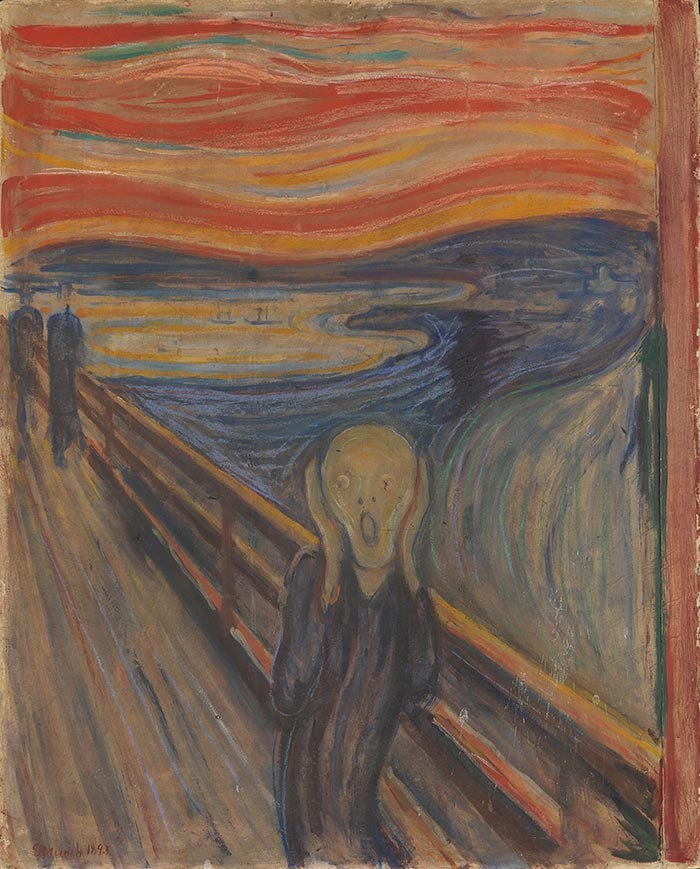
The painting resides at the National Museum of Norway, Oslo.
Looking at the scream, you see a person, in the middle of a panic attack, with his mouth open, hands covering his ears. He and the nature around him are all wobbly and curving. Two men walking in the back, straight, undisturbed and unaware, because they don’t feel the same as him. It is only Munch who is either screaming or can hear the scream. The painting looks terrifying, both for the person and the viewer.
For me, the scream is raw and honest, not just because of the emotion painted over it, but also because it is painted on cardboard. To think that Munch took a piece of cardboard, maybe an old one, and painted the haunting experience over it, gives the painting an emotional weight.
Panic attacks are so difficult to explain in words. To some, it is the world screaming at them; to others, it is their heart and soul screaming at them; and to some, there is no noise but the unbearable weight of the quiet. Munch expressed all of these in his painting. To each viewer, who has experienced anxiety and panic, ‘The Scream’ offers their personal experience to them.
He painted four other versions of the artwork: the pastel version in 1893; the lithograph version in 1895; the second pastel version, also in 1895; and the tempera version in 1910.
Pastel Version, 1893
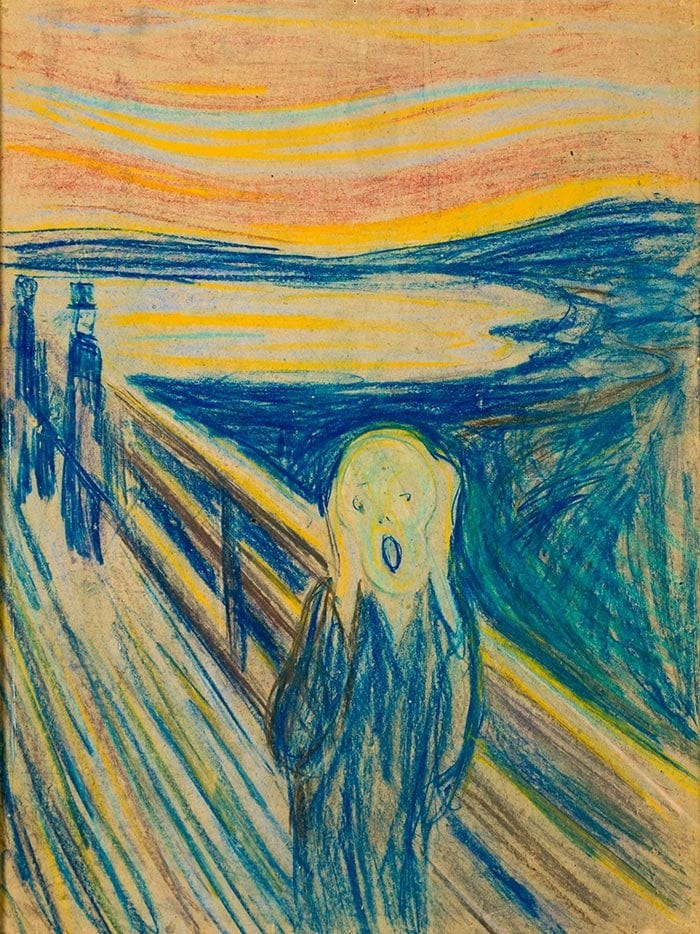
The pastel version of 1893 resides at the Munch Museum in Oslo. With blurred edges of terror, and colors that look washed out and dreamlike, the person looks disconnected from reality. Like he has entered a realm where everything is merging with the screams he hears. All of it feels like a slow-moving horror, a never-ending nightmare.
Nightmares have affected me for as long as I can remember. The ever-repeating dream, being unable to wake even when I realize I am dreaming. The panic attacks while in sleep are what being disconnected from reality feels like. I try and try to wake up, get out of the paralysis but I can’t and everything dissolves within the dream.
Lithograph Version, 1895
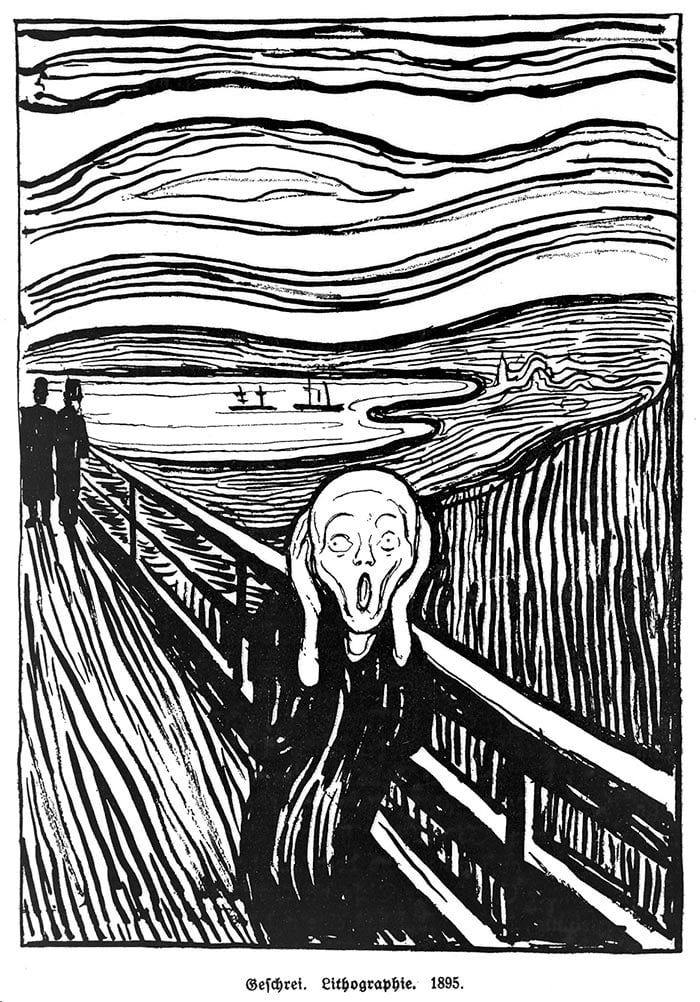
A lithograph print is made by drawing a design onto either a flat stone or a prepared metal plate and uses the natural repulsion between oil and water to create the print.
By making lithographs of the painting, Munch made it available to a wide audience, rather than keeping it confined within the museum or a private collection.
Major museum prints of this rare lithograph reside in institutions like the Museum of Modern Art (MoMA) in New York, the Art Institute of Chicago, and the Metropolitan Museum of Art.
Stripped of all color, lithographs rely entirely on the heavy black ink and stark white surface to convey the emotion. Without the distracting beauty of the sunset, the focus turns to the darkness within the artwork.
This version feels like being claustrophobic but trapped within the prison of the mind that I don’t fully understand. Like I know why I am sad and depressed, but there is just no escape, no color within life. No help can reach me and so I must give up. But I cannot because I have been given this life and I will have to live this one. I cannot escape and thus the panic.
The Second Pastel version, 1895
This pastel version of the scream currently resides in a private collection, sold for $119.9 million on 2nd May, 2012.
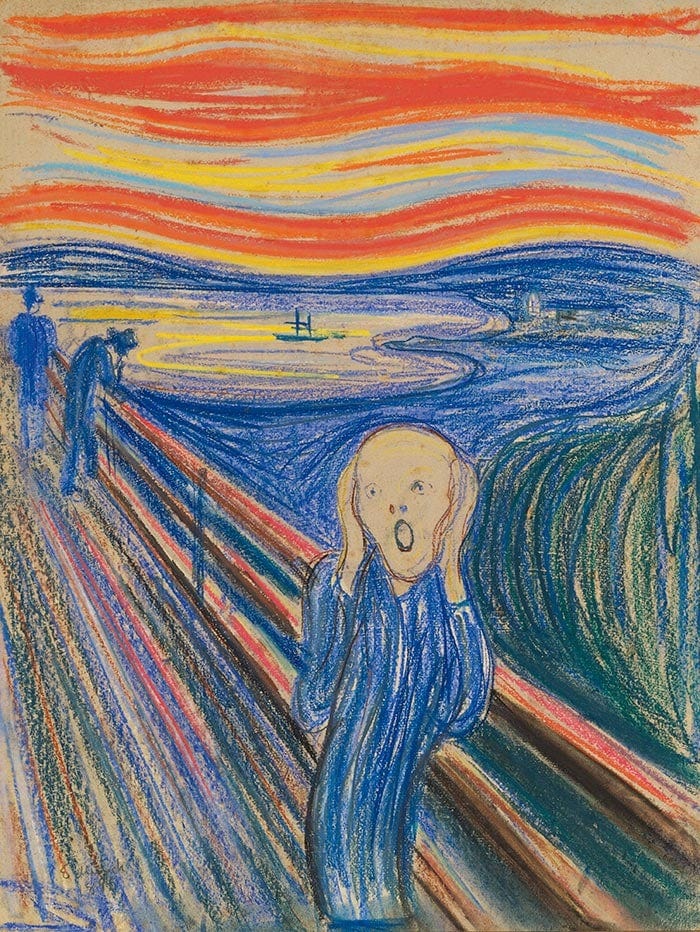
This is the most vibrant and violently colorful version. The streaks of the sky are sharp and bold. The two men in the back are also in a different position than in all the other versions. Maybe they are feeling something themselves or maybe they are just looking the view around them.
You can see different strokes of colors, which makes it look more like a line painting, distorted and curved lines.
This version of the panic attack, to me, resonates with the one you have in public. Where all is loud and vibrant. Everyone around you is minding their own business. You are maybe in a market or in a club, surrounded by many, yet isolated. And now you will have to hide all this within yourself, but it is hard to contain and will escape you.
The Tempera Version, 1910
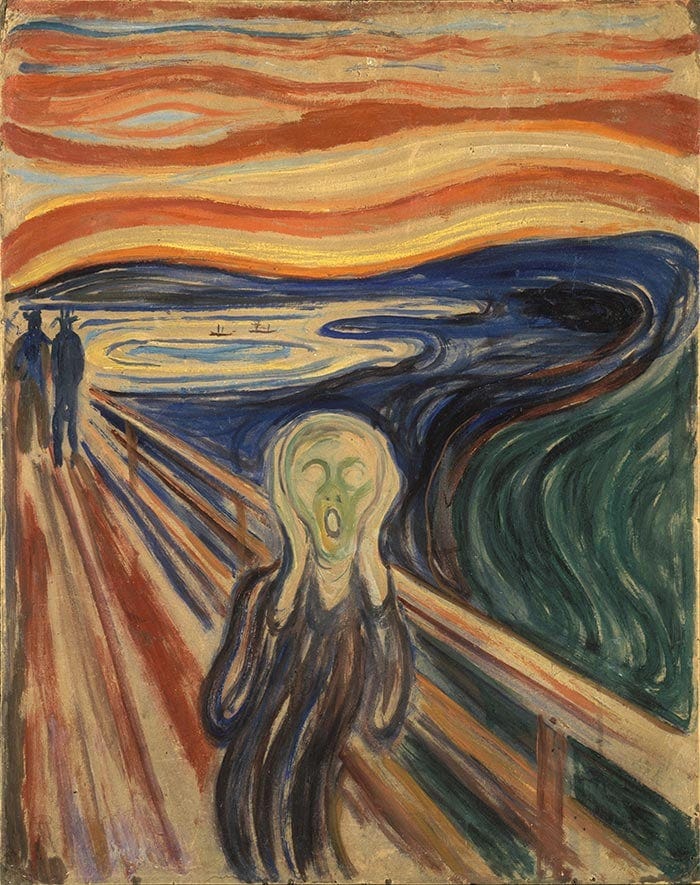
Edvard Munch revisits his memory of the day and paints The Scream again. The painting currently resides in the Munch Museum, Oslo.
Using tempera on cardboard, he paints everything dull, blurry and ghostly again. It feels like the echo of the pain that still lives within him.
“For as long as I can remember I have suffered from a deep feeling of anxiety which I have tried to express in my art.” - Edvard Munch
Munch lost his close family members at a young age. His sister was fighting illness. All this grief and sadness manifested itself as panic attacks and anxiety.
This version is a lived memory. Not a lost one, but a continuous one. Maybe that is why it is so ghostly and merged. Unlike other versions of The Scream, the person in this one has hollow eyes. Maybe because there is nothing left to see anymore or maybe because he doesn’t want to see anymore. Either way, this version is as much present as it is past. It is sad and depressing because some wounds never heal.
Each one of us has a different story about when we might have felt exactly like the scream. Maybe we want to share that story. Maybe we want to keep it hidden. Reading something or looking at an artwork that expresses exactly the way I feel gives me some sort of relief. Maybe because I can see that I am not alone in feeling this way, that we are all alike. Relatability has a magical way of healing or maybe it just allows us to sit with the feeling. Either way, The Scream is that painting to me. A lot of other artworks are too. But The Scream has sat with me a lot of times. It has kept me company when I didn’t want to share my thoughts.
I wasn't aware that these many versions of Scream existed until I read your post and thank you for shedding more light on this masterpiece. Also, what you mentioned towards the end wrt relatability. I guess that what makes us sit up and notice such artworks too I guess. Somewhere we see ourselves. Somewhere there's a connection we long for from others when we seek empathy and that is found in such art from a creator who is distant in time and place. Keep writing. Keep sharing. Keep going.