
Grief represented in Art
All who have loved, have grieved.

Grief, once felt, remains with us forever. No amount of anything can paint over it. Grief has different shades. It is universal, but still personal. When we try to express grief, words often fail. So we turn to silence. I do the same. Yet where words fail, art speaks. Art has the power to express the inexpressible — and so it does.
Melancholy, by Albert György
Melancholy is the statue that sits on the shores of Lake Geneva in Switzerland. It encapsulates the hole that comes with losing someone. Albert György made it after he lost his wife. The statue shows what’s missing rather than what is present.
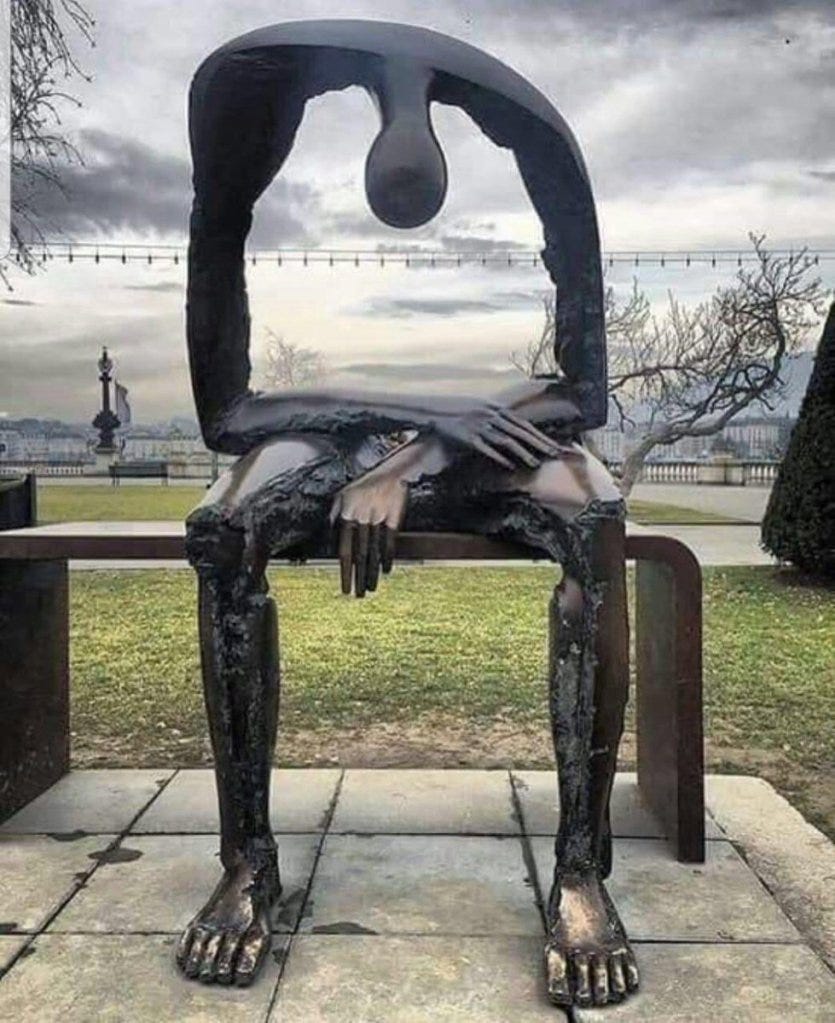
To me, the statue is like the sigh I give when someone asks me anything about the people I am grieving. It’s like I have nothing to say, but at the same time I have so much going on within me. Almost like a black hole. Melancholy is one of the artworks I keep coming back to, just so I feel understood.
Henry Ford Hospital, by Frida Kahlo
Frida Kahlo lived a life of pain, loss and grief. Yet she carried herself through it all, expressing her raw emotions in her paintings. In Henry Ford Hospital, she grieves both her unborn child and herself. She had wanted, desperately, to be a mother. At 18, she had a near-fatal bus accident that forced her to wear restrictive full-body casts and was bedridden for months. This accident was an injury her body never recovered from.
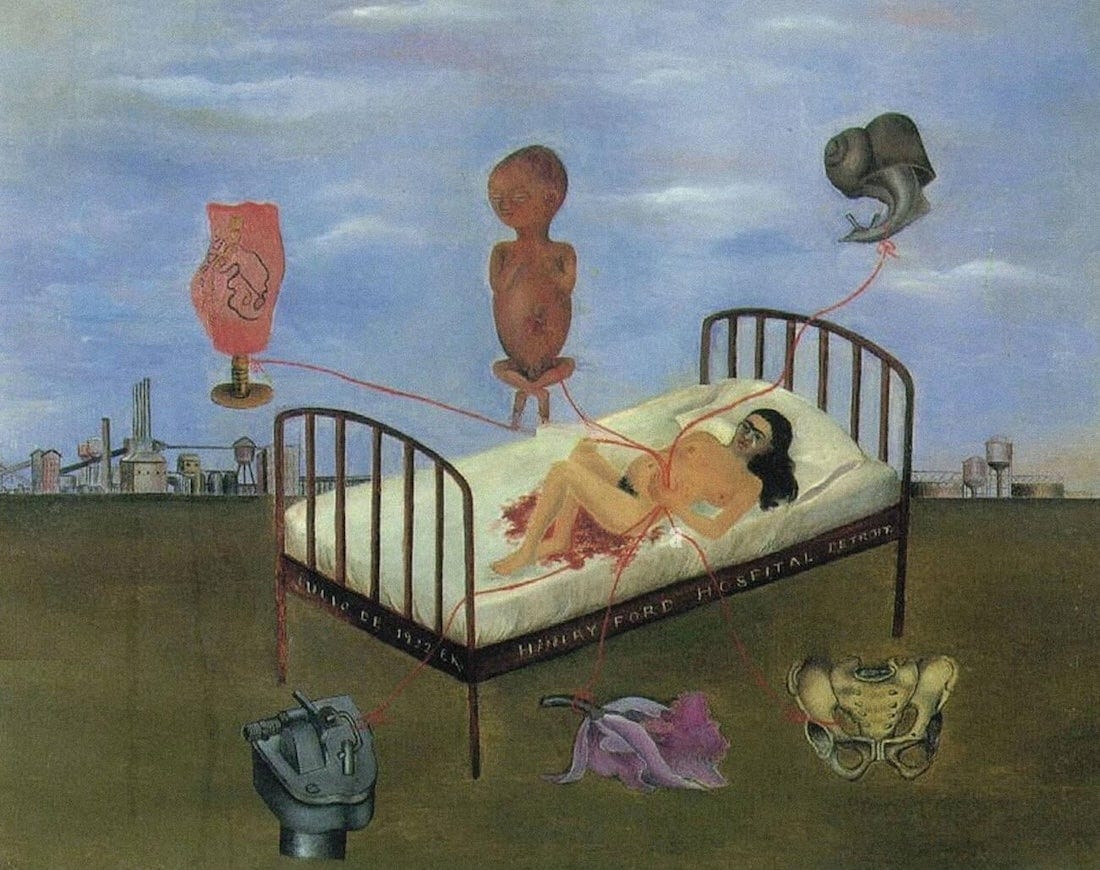
In Henry Ford Hospital, I see Frida Kahlo crying for her unborn child and herself. I see her pain throughout her life. I see how she was incapable of helping herself. Frida Kahlo’s work, however sad the paintings, always carry a hint of hope. But Henry Ford Hospital and Sin Esperanza are the ones where I see no hope, only sadness. In both, she is bedridden, one from the accident, another from the miscarriage.
Ivan the Terrible and His Son Ivan on 16 November 1581, by Ilya Repin
Ilya Repin's Ivan the Terrible and His Son Ivan captures the moment right after Tsar Ivan IV struck his own son with his staff in a fit of rage — a blow that would kill him days later. Painted between 1883 and 1885, it is housed at the Tretyakov Gallery, Moscow, Russia.
This painting introduces us to a shade of grief mixed with regret. The grief we bring upon ourselves.
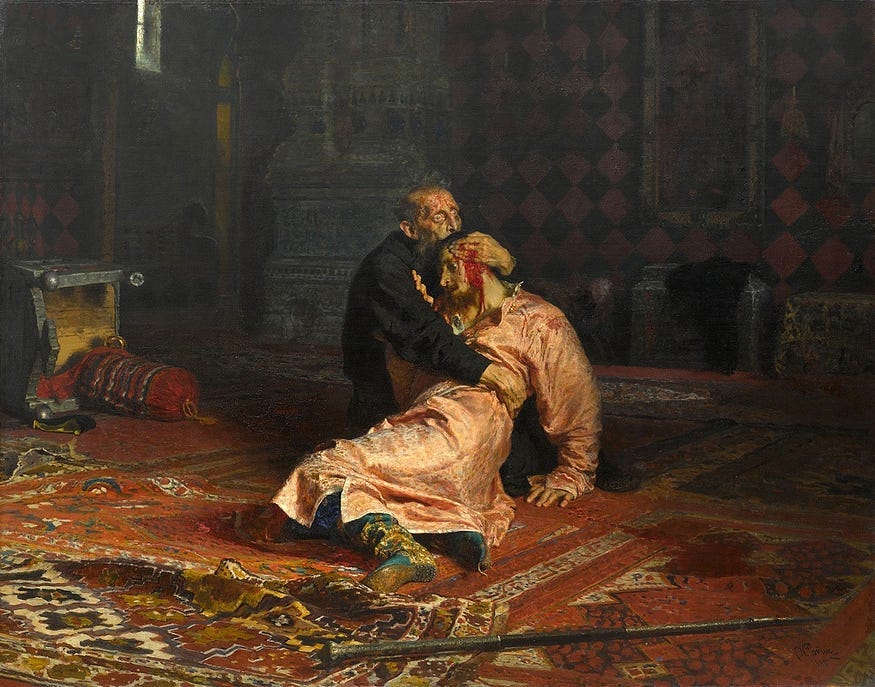
There are times when we do something we didn’t mean to, but what’s done is done. Ivan had just mortally hurt his son. He didn't mean to. There is regret and shock in his eyes. He holds his son's dying body, the son he killed with his own hands. I wonder how many times Ivan denied himself the right to grieve because he was the reason. What’s done is done and cannot be undone, and there is a whole life to live with it.
Can't Help Myself, by Sun Yuan and Peng Yu
Can't Help Myself was a haunting 2016 kinetic art installation by Sun Yuan and Peng Yu, featuring an industrial robotic arm confined in a glass case, programmed to sweep a spreading, blood-red fluid back into place. Over the years, its movements grew slower and more erratic by design, until the artists chose to permanently turn it off in 2019.
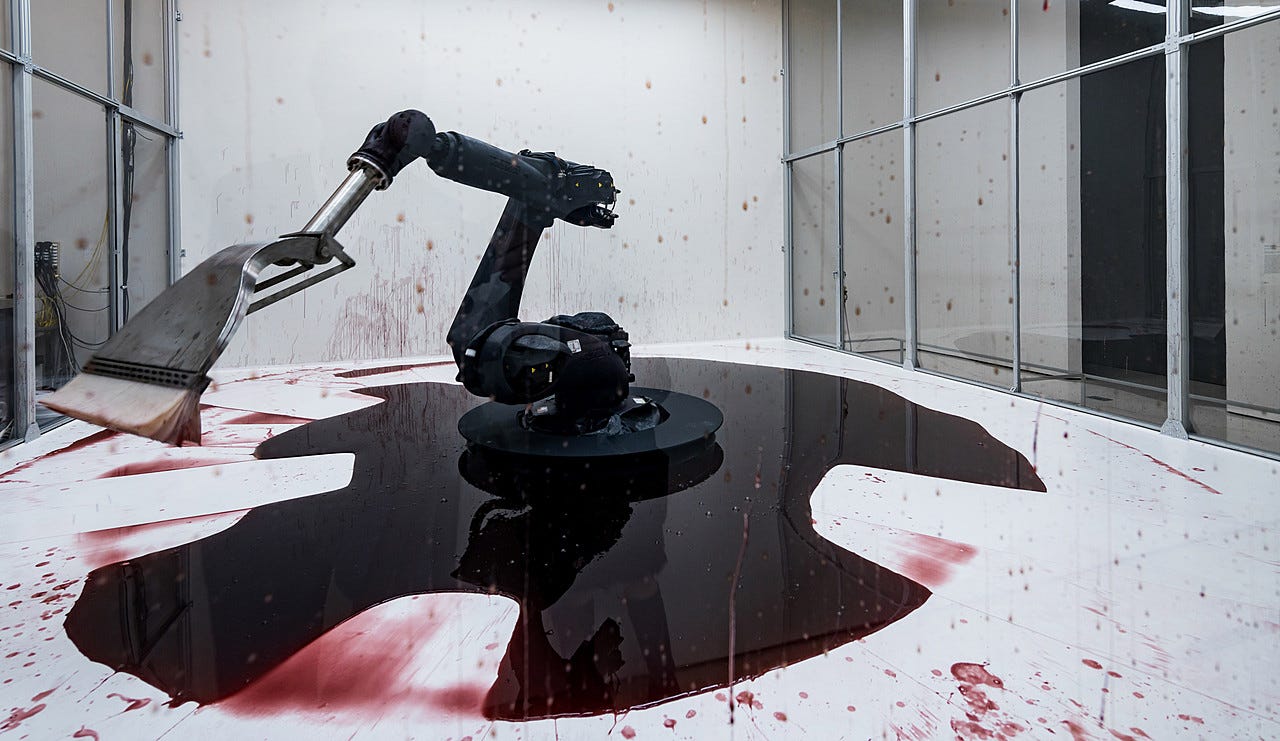
Though robotic, Can’t Help Myself represents the grief we hold for ourselves. We have dreams and hopes and desires, some of which we could never bring to reality, no matter how hard we tried. Eventually we stop trying. And now the trying is replaced by grief for what we never finished. This shade of grief is internal, not seen by anyone, rarely felt, but when it surfaces, it takes over completely.
"Grief is a circular staircase," Linda Pastan wrote, and I have always loved that line. It says so much in so few words. People have said that there are stages to grief, and the last is acceptance. But the cycle starts again. When I want to express grief I turn to poetry. And when I can’t find words, I turn to visual art. But mostly, just like everyone, I turn to silence.
Grief first visited me when I was five. I hardly knew what it was, but I knew my grandfather was not here anymore. It’s been a year now since I lost my father. Even now, I don’t know exactly what it is, but I know my father is not here anymore. Over the years, I have lost so many people I have loved. There are times when I lost myself too. I grieve them all. There is no end to it.
You never stop grieving. Because they will never come back.
If a painting or an artist has stayed with you and you’d like a personal essay on what they carry, I’ve opened a small space for that on Ko-fi.
If Still Sparrow means something to you, your support on Ko-fi keeps the gallery open.
I felt it so much while reading this! It is crazy how art can speak so much without saying anything.
While reading this, I also kept coming back to the Melancholy statue. The way that art can just can express things we might not be able to have the words to describe always amazes me.
The part where you talked about how you lose parts of yourself when you lose someone - felt that! I feel like a little bit of you dies when you lose someone. But hopefully we can channel that grief into honoring them. Beautiful piece ♥️